


 67 Monroe Avenue, Pittsford, NY 14534 / 9am - 4pm M-F




KEY TAKEAWAY
If you sell investment real estate for a profit, you may owe taxes on the sale. A 1031 exchange may allow you to reinvest the proceeds into another qualifying real estate investment and postpone recognizing the gain for tax purposes. That can keep more of the sale proceeds invested today. A Delaware Statutory Trust, or DST, can offer a more passive way to complete an exchange without directly managing another property.
You Are Selling Investment Property. What Happens Next?
Imagine you purchased an investment property years ago and it has increased significantly in value. If you sell it, the gain may create a meaningful tax bill. A 1031 exchange may allow you to postpone recognizing that gain by reinvesting in another qualifying real estate investment.
Think of a 1031 exchange less as avoiding taxes and more as postponing them while keeping more of your money invested.
How a 1031 Exchange Works
Section 1031 of the Internal Revenue Code allows an investor to defer recognition of gain when investment or business real estate is exchanged for qualifying like-kind real property. The tax is deferred, not eliminated, and the tax basis generally carries from the property sold into the replacement property.
Two deadlines are especially important:
- 45 days: You must identify potential replacement property after the sale.
- 180 days: You must complete the purchase of the replacement property.
The transaction must also be structured properly. A qualified intermediary should generally be engaged before the sale closes so the investor does not take possession of the proceeds
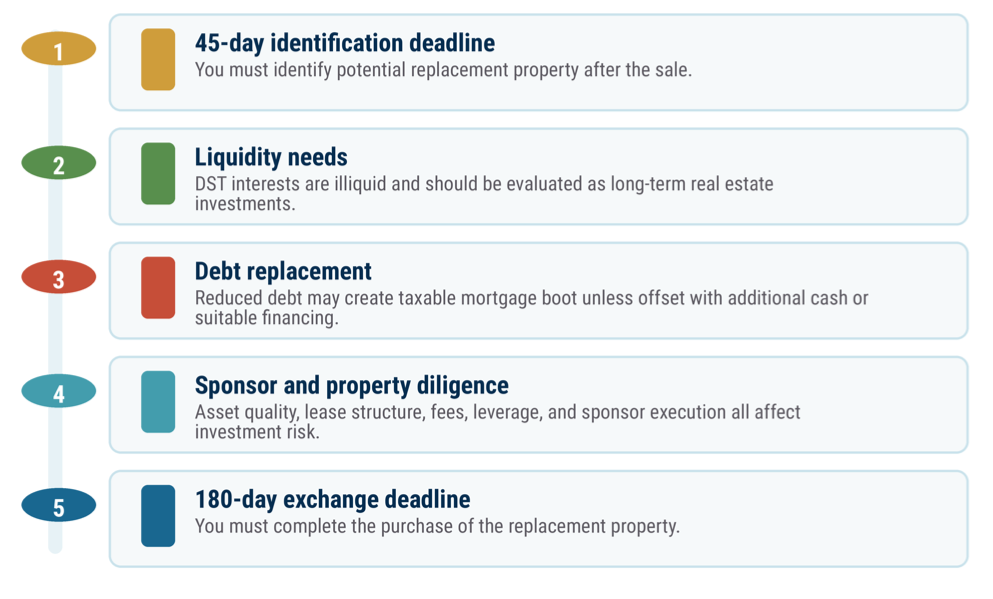
Statutory timing requirements for a typical 1031 exchange.
Why Consider an Exchange?
The primary benefit is straightforward: a properly structured 1031 exchange may allow more of the sale proceeds to remain invested today rather than being used to pay taxes immediately. A taxable sale can trigger capital gains tax, depreciation recapture, net investment income tax, and state or local taxes.
What the illustration below is meant to show: by deferring taxes through a qualifying exchange, an investor may have more proceeds available for reinvestment. The actual tax result depends on the investor’s individual circumstances.
| Illustrative Example | Taxable Sale | 1031 Exchange |
|---|---|---|
| Purchase Price | $750,000 | $750,000 |
| Depreciation | $500,000 | $500,000 |
| Adjusted Cost Basis | $250,000 | $250,000 |
| Sale Price | $1,750,000 | $1,750,000 |
| Estimated Taxable Gain | $1,500,000 | $1,500,000 |
| Federal Capital Gains Tax | $200,000 | — |
| Depreciation Recapture Tax | $125,000 | — |
| Net Investment Income Tax | $199,500 | — |
| State Tax Impact | $163,500 | — |
| Total Estimated Tax Impact | $581,500 | — |
| Net Proceeds Available for Reinvestment | $1,168,500 | $1,750,000 |
Illustrative only. Tax impact will vary based on client-specific facts, tax brackets, state and local rules, debt, selling costs, and whether all 1031 exchange requirements are satisfied.
Illustrative only. Tax impact will vary based on client-specific facts, tax brackets, state and local rules, debt, selling costs, and whether all 1031 exchange requirements are satisfied.
Illustrative only. Tax impact will vary based on client-specific facts, tax brackets, state and local rules, debt, selling costs, and whether all 1031 exchange requirements are satisfied.
What If You Don’t Want Another Property to Manage?
A 1031 exchange can create a practical question: what if you want to stay invested in real estate, but you do not want to buy and manage another building yourself?
A Delaware Statutory Trust, or DST, may provide an alternative. A DST is a legal structure that allows multiple investors to own beneficial interests in real estate held by the trust. When properly structured, a DST interest can qualify as replacement property for a 1031 exchange.
For some investors, a DST may offer:
- A more passive ownership experience with professional property management
- Access to institutional-quality real estate
- The ability to diversify across properties, sponsors, asset classes, or geographic markets
- Continued potential tax deferral when exchange requirements are satisfied
- Potential flexibility when considering long-term estate and wealth transfer planning
DSTs can reduce day-to-day responsibilities such as tenant management, maintenance, leasing, capital improvements, and direct property administration. Fractional interests may also be easier to divide among beneficiaries than one directly owned property, although tax and legal planning remain important.
One Important Detail: Your Mortgage Matters
In a 1031 exchange, it is not enough to look only at the value of the property you are buying. The amount of debt involved can matter too.
For example, if a property is sold with an $800,000 mortgage and the replacement property includes only $600,000 of debt, the $200,000 reduction may be treated as taxable mortgage “boot.”
Depending on the situation, investors may be able to address a debt shortfall by contributing additional cash, selecting replacement property or DST investments that include debt, or accepting a portion of taxable gain. Careful planning can help align the exchange with liquidity needs, tax considerations, and long-term objectives.
Looking Further Ahead: A Potential 721 Exchange
This is a more advanced planning strategy. Certain DST programs may offer a future opportunity to exchange into a professionally managed REIT structure through a Section 721 transaction. This path is not guaranteed, but it may offer continued tax deferral, broader diversification, and possible liquidity options over time.

Risks and Considerations
DSTs and related exchange strategies are complex and generally illiquid. They are subject to real estate market risk, tenant risk, financing risk, valuation risk, sponsor execution risk, and possible loss of principal.
Before proceeding, investors should consider fees, leverage, sponsor experience, asset quality, lease structure, distribution assumptions, exit strategy, tax reporting, liquidity needs, and how the investment fits within the broader portfolio.
Definitions
| Term | Definition |
|---|---|
| 1031 Exchange | A way to reinvest proceeds from investment real estate while potentially postponing recognition of gain for tax purposes. |
| Replacement Property | The qualifying real estate investment acquired as part of the exchange. |
| DST | A legal structure that allows investors to own beneficial interests in professionally managed real estate held by a trust. |
| Qualified Intermediary | An independent party used to help facilitate the exchange so the investor does not take possession of the sale proceeds. |
| Boot | Cash, property, or debt relief in an exchange that may create a taxable amount. |
| Tax Deferral | Postponing recognition of certain taxes rather than eliminating them. |
Final Thoughts
For investors who want to defer taxes, simplify real estate ownership, and maintain exposure to professionally managed real estate, a DST can be a useful planning tool. Successful exchanges require coordination around timing, debt replacement, taxes, liquidity, and long-term wealth planning.
At LVW Advisors, we help clients evaluate 1031 exchanges, DST investments, and related planning opportunities in coordination with tax and legal advisors. If you are considering the sale of investment real estate, we welcome the opportunity to discuss how these strategies may fit within your broader wealth plan.
Sources
Information for this memo was obtained from Internal Revenue Code Sections 1031 and 721, IRS Revenue Ruling 2004-86, Hines tax-deferred exchange educational materials, Blackstone Real Estate Exchange (BXREX) offering materials, and LVW Advisors research and due diligence regarding Delaware Statutory Trust and 721 exchange strategies.
Important Disclosure
This information is provided by LVW Advisors for general information and educational purposes based upon publicly available information from sources believed to be reliable. LVW Advisors cannot assure the accuracy or completeness of these materials. The information presented here is not specific to any individual’s personal circumstances and should not be construed as tax, legal, accounting, or investment advice. To the extent that this material concerns tax matters, it is not intended or written to be used, and cannot be used, by a taxpayer for the purpose of avoiding penalties that may be imposed by law. Each taxpayer should seek independent advice from a tax professional based on his or her individual circumstances. The information in these materials may change at any time and without notice. Tax-deferred exchange transactions, including 1031 exchanges, Delaware Statutory Trust investments, and 721 exchange strategies, involve complex tax and legal considerations and are not appropriate for all investors. Investors should consult their tax advisor, attorney, qualified intermediary, and financial advisor before implementing any exchange strategy. Real estate investments involve risk, including illiquidity, loss of principal, market risk, tenant risk, financing risk, and sponsor execution risk. Past performance does not guarantee future results.
Educational use only. Not tax, legal, or investment advice.